
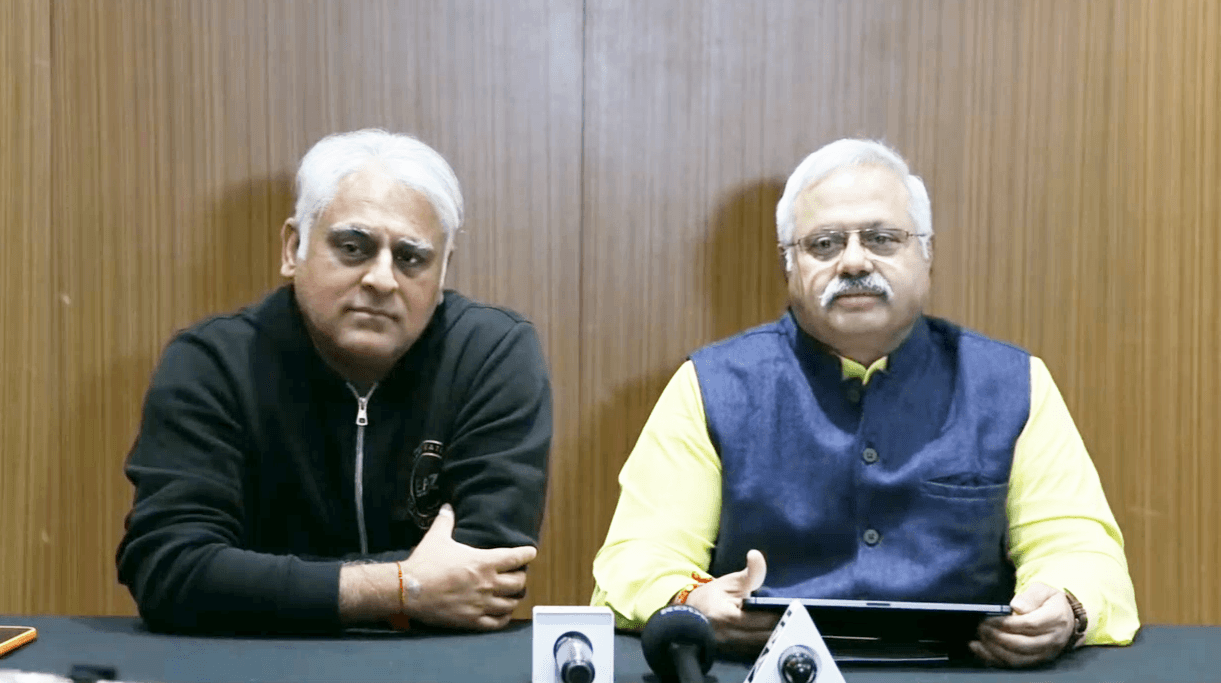
The Rashtriya Swayamsevak Sangh (RSS) has called for a nationwide National Register of Citizens (NRC), arguing that identifying citizens was necessary to address what it described as “population imbalance” and protect India’s “unity, integrity and security”.
Speaking at an event at the Indira Gandhi National Centre for the Arts (IGNCA), RSS publicity in-charge Sunil Ambekar said there was a need to identify people who had been “wrongly included” in electoral rolls and ensure citizenship for those who had entered India from neighbouring countries and are eligible under the Citizenship Amendment Act (CAA).
“When solutions (to population imbalance) are discussed, it is said there should be a National Register of Citizens,” Ambekar said. He linked the issue to the 1947 Partition, arguing that population balance was particularly important for India because the country had been divided on religious lines.
Ambekar said people who had remained in neighbouring countries that became Islamic states after Independence, particularly those from Scheduled Caste, Scheduled Tribe and economically weaker sections, had faced persecution.
“For those who have come back, ensuring their citizenship through CAA is necessary. Identifying such people through the NRC is necessary. If people have been wrongly included in the voter list, it is necessary to identify them,” he said.
He said objections to the process could be dealt with through existing legal mechanisms, including courts, but argued that accepting a non-citizen as a citizen “for purely political reasons” would be wrong.
Ambekar also framed demographic change as a cultural and national security issue. He argued that every nation had an identity and that maintaining what he described as an “equilibrium” among people who consider the country’s culture their own was necessary to preserve its cultural identity.
“Every nation has an identity. If the population of such people who consider the culture of the country as their own remains in equilibrium then the cultural identity of the country is preserved,” he said, adding that protecting India’s culture should not be described as communal.
The RSS leader also criticised successive governments for failing to formulate what he called a “concrete policy” on population and the Census after Independence. He said population control had been presented as a solution to India’s problems, particularly before the Emergency, but a comprehensive policy was not framed until the National Population Commission was established in 2000 under the Atal Bihari Vajpayee government.
Ambekar also cited differences in laws governing marriage, minority educational institutions and population-control provisions for local body elections, arguing that policies framed in the name of secularism had contributed to demographic disparities.
“Some people were allowed to have four marriages. There was no such law before Independence. But Hindus were told that more than one marriage would be punishable. The law should be uniform,” he said.
He further criticised the handling of illegal immigration, referring to the Illegal Migrants (Determination by Tribunals) Act, 1983, which was struck down by the Supreme Court in 2005. He alleged that ignoring illegal immigration had been part of a policy framed under the idea of secularism.
The RSS has consistently backed a nationwide NRC. In 2019, then RSS general secretary Suresh Bhaiyyaji Joshi said it was the government’s responsibility to prepare an NRC to identify people who were not Indian citizens. RSS chief Mohan Bhagwat said in 2021 that the NRC was meant to determine genuine citizens and should not be viewed as a Hindu-Muslim issue.
The NRC became a major political issue during the protests against the CAA and proposed NRC in 2019-20. Prime Minister Narendra Modi said in December 2019 that his government had not discussed an NRC since coming to power. The BJP subsequently did not include a nationwide NRC in its 2024 election manifesto.
The issue has gained renewed attention amid the Census exercise. The current Census questionnaire includes questions on nationality and details of parents, Aadhaar and voter ID, among other details. The statutory framework also provides for verification of the Population Register for preparing the National Register of Indian Citizens and identifying cases where citizenship may be considered doubtful.
However, there is currently no government notification announcing a nationwide NRC. The National Population Register (NPR) exercise, which was scheduled alongside the 2021 Census, was postponed during the Covid-19 pandemic and was not re-notified when the Census process was revived.

Comments (0)