

Is Cockroach resonating with India’s students?
The parody party has amassed massive fame. But is it voicing concerns of India’s diverse student population?
Eight shots of gunfire in the air, tear gas, and lathi-charge. At Patna’s Pataliputra Station, hundreds of exam-bound students protesting the lack of adequate trains for the Police Prohibition (Excise) Constable examination were met with force on June 14.
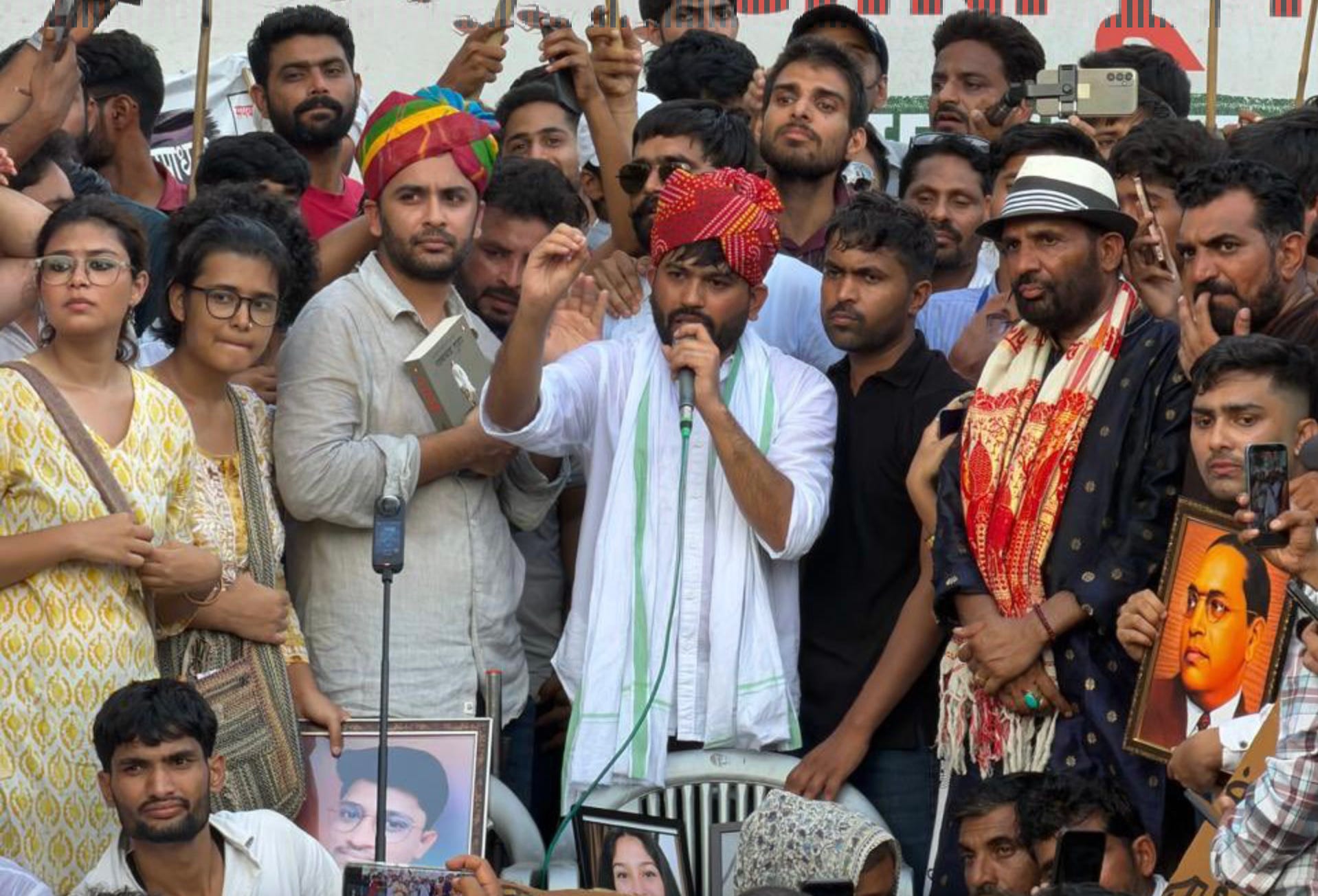
On the same day, another set of students, rain-soaked, jammed to Michael Jackson’s They don’t really care about us at the satire collective Cockroach Janta Party’s (CJP) protest against paper-leak at Bengaluru’s Freedom Park. A clip showed a sea of mobile flashlights as CJP founder Abhijeet Dipke named students whose suicides were allegedly linked to the recent exam scams.
In the week after its seven-day ultimatum to sack Education Minister Dharmendra Pradhan on June 6, the collective’s representatives have travelled to six cities to rally support. Its protests are marked by careful media interaction, high-profile activists, and a mixed crowd of a few hundreds in the audience.
The campaign has got wide media coverage across the world. The BBC has dubbed CJP as India’s “political superstar”, Guardian said it reflects youth anger and is “threatening to shake up India’s politics”, while an op-ed in Al Jazeera read that the movement has “rattled” the Prime Minister. The collective has also announced a “Roachmap” of five demands in addition to its original five-point manifesto and Pradhan’s resignation. But the question is: Does the CJP resonate with the students beyond social media?
Critics have contrasted the few hundred protesters at its offline protests with the movement’s claim of eight hundred thousand online signatures demanding Pradhan’s resignation. So far, it is also struggling to build alliances with other student-led protests happening across the country.
At a recent Lucknow protest over alleged Lekhpal exam irregularities, which Dipke joined, some media reports suggested that the students accused him of “trying to gain political mileage” and refused to let him speak. The criticism may be rooted in Dipke’s background as a political activist with the Aam Aadmi Party (AAP) and his lack of traditional association with a student union.
The protest in Patna too was a departure from Dipke’s calls for non-violence and offering flowers to cops. However, it did not emerge in a vacuum. For weeks, media reports documented aspirants crammed into overcrowded trains and buses across Uttar Pradesh and Bihar as they struggled to reach examination centres. For many aspirants, exam centres were allocated more than 100 kms away from their hometowns, purportedly to prevent paper leak.
A student quoted in news agency ANI said there were “14 lakh aspirants” but only two trains from Pataliputra. A story in The Print, noted that the UP police constable exam is “a dream shared by the nearly 29 lakh candidates” and the “swelling crowds of aspirants are evidence of just how many young people are chasing it.” These issues, however, haven’t found a representation in the CJP.
Instead, the CJP’s “Roachmap”, demands 10,000 rupees paper leak commission for every student, mandatory backup exam day within 72 hours, paper checking for paper exams, automatic age limit extension for delayed exams or results, and mandatory tech and tender audit.
The collective has also called for an indefinite sit-in at Jantar Mantar from June 20, demanding Pradhan’s resignation. Dipke said he is ready to even go to jail. “For how long are we going to fear these people? For how long are we going to be scared of them? Now, we need to make sure that no matter what happens, if we have to go to jail, we will go to jail, but we will go for freedom. I will be the first one to go to jail.”
The campaign, meanwhile, has also recorded backlash. CJP spokesperson Saurav Das faced social media trolling over his Tamil-language appeal urging students to join the Bengaluru protest. Several users on X, questioned why the call was in Tamil instead of Kannada. Das eventually deleted the post. Another CJP spokesperson, Vijeta Dahiya, was called out by queer social media accounts over his transphobic statements made in online interactions earlier.
At a protest in Jaipur, Dipke was manhandled and slapped. “Carry out not one but a hundred attacks, but we won’t be silenced,” he later said. For now, the CJP continues to draw headlines. But beyond the flashlights and viral clips lies their larger test.