
Is CJP finally lighting a political fire?
Welcome to The Decifer’s weekly newsletter.
A systemic theft at India’s newest and grandest site of Hindutva assertion, the Modi government’s countdown to the Monsoon Session, the Cockroach Janta Party’s growing momentum, a shift in global politics, and why the narcotics bureau has become “toothless” — this week was chock-full.
God in crisis, and a much-awaited Monsoon Session
The theft of “more than Rs 200 crore” in donations from Ayodhya’s Ram Mandir has put the spotlight on the temple’s management body, the Shri Ram Janmabhoomi Teerth Kshetra Trust, and its general secretary, Champat Rai. The senior Vishwa Hindu Parishad leader, a key figure in the Ram Janmabhoomi movement that culminated in the razing of the Babri Masjid and the construction of the Ram Mandir, resigned on June 27.
So far, eight have been arrested, including Rai’s close aide and driver Tinnu Yadav — who the former has accused of being a “key figure” in the alleged scam and of leaking information to the Samajwadi Party before being caught.
However, the trust’s former accounts department employee, Mahipal Singh, is reported to have first brought the alleged scam to public notice. He was purportedly replaced after raising concerns about the mishandling of donations and now fears for his life. Investigation is going on and the police have made some recoveries.
India, meanwhile, has recorded its driest June in 12 years. But it is a different monsoon the Modi government is waiting for — the Monsoon Session of Parliament. The NDA is reportedly preparing to introduce the delimitation and Lok Sabha seat expansion Bill, while speculation is also rife over the possible restoration of statehood to Jammu and Kashmir. The session will begin on July 21.
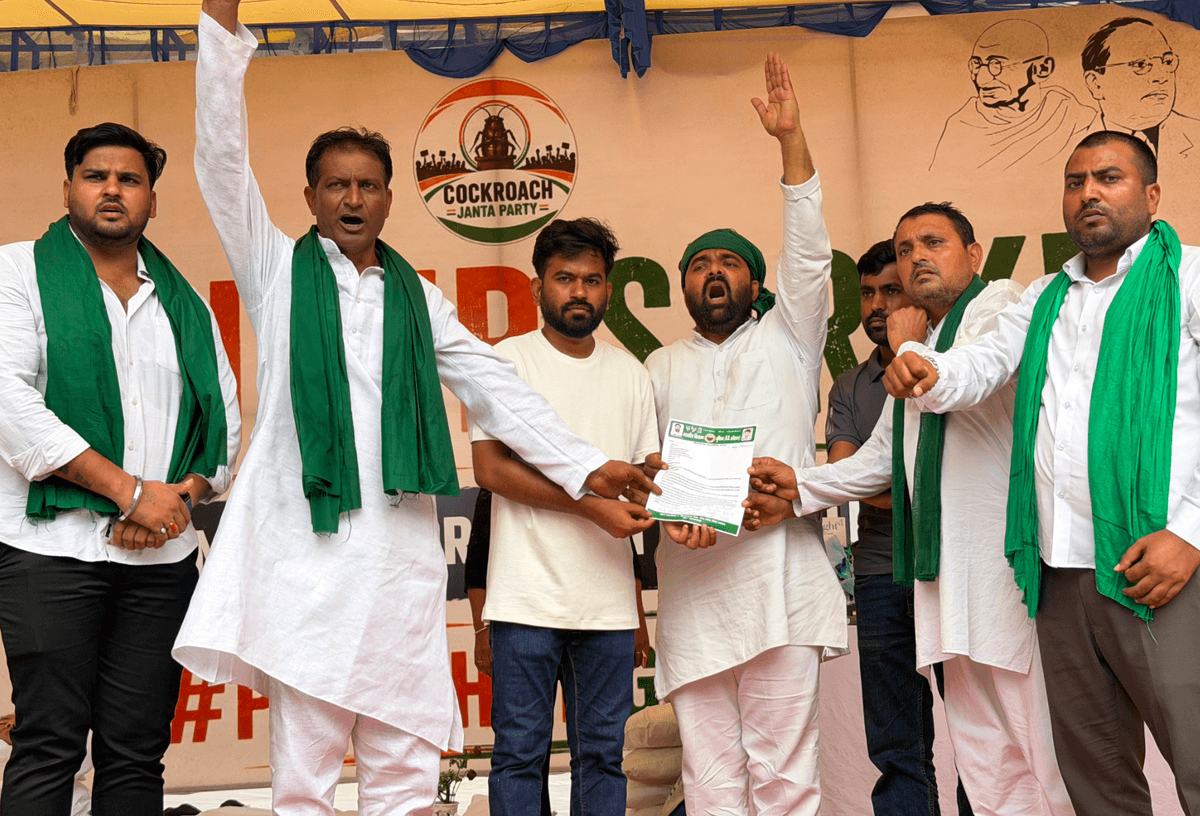
Is CJP finally lighting a political fire?
The protest site at Jantar Mantar has turned into a hunger strike venue. Ladakhi activist Sonam Wangchuk has been lying on a small mattress on the Cockroach Janta Party stage, fasting since June 28. Off the stage, six activists from CPIML-Liberation’s student wing AISA and nine others are also on hunger strike with one demand: Education Minister Dharmendra Pradhan’s resignation.
On day 13 of the protest, and fifth day of Wangchuk’s hunger strike, his blood sugar level dropped to 60. Meanwhile, CJP founder Abhijeet Dipke launched “Chai Pe Charcha with Cockroaches” for feedback from protesters as the movement expands. The CJP stage also hosted two Opposition leaders — Anish Gawande of NCP Sharad Pawar and Sagarika Ghose of Trinamool Congress.
It also got the Bharatiya Janata Party fuming, with the party finally breaking its silence — albiet with jibes. Party National President Nitin Nabin called the CJP a “virus and cockroach gang”, accusing the protesters of being a part of the “tukde-tukde gang”. The phrase, ubiquitous during the anti-CAA protests, made a striking comeback.
Nabin added that the cockroaches aim “to destroy” and “break the country into pieces”, promising that BJP workers will ensure they are “taught a lesson”. His response was a far cry from accountability. It is, however, consistent with Pradhan’s own jibe, in which he called the protesters “the B-team of disruptive elements”.
A shift in global politics — and its fuel
The world order may be changing in plain sight. Russia’s pivot to Asia appears to be gathering momentum, while South Asia is carving out its own place at the geopolitical table. As President Vladimir Putin hosted ASEAN leaders in Kazan to strengthen ties, analysts have pointed to the scope of the country emerging as a “third power” in the region.
However, the war in Ukraine, as an article in The New Yorker detailed, may have finally put Putin under domestic pressure. Ukraine has been intensifying attacks — seeking to turn the tide of war in its favour. With refinery operations disrupted, queues at petrol stations, and fuel consumption restricted in Crimea after recent strikes, Putin has made a rare admission of fuel shortages. A BBC report has described it as “unusually frank”.
While the Kremlin has not softened its demand that Ukrainian forces withdraw from the four southeastern regions, it has turned to India for relief from fuel shortages. In a reversal of roles, India has now dispatched two ships with at least 60,000 metric tonnes of gasoline to its biggest crude oil supplier.
Bangladesh Prime Minister Tarique Rahman’s visit to China, meanwhile, is being called “significant” for its potential to reshape the country’s diplomatic alignment. Dhaka is seeking fighter jets, port investments and loans from China, while both the USA and India remain wary.
On the contrary, India is seeking to bolster strategic ties with Japan, looking to attract 10 trillion yen in investment. While the country negotiates trade deals with the US as well, it has sent junior officials to attend the funeral of Iranian Supreme leader Ali Khamenei. An invitation that Iran also extended to Opposition leader and Congress President Mallikarjun Kharge.
Missed a story? A ‘toothless’ narcotics watchdog — why?
India’s growing narcotics crisis isn’t just about addiction, but also enforcement. An estimated 2.2 crore people are affected by heavy drug use, while trafficking networks exploit the country’s northwestern and Indo-Myanmar borders, with Punjab and several northeastern states becoming key hotspots. Yet the Narcotics Control Bureau, India’s frontline anti-drug agency, is operating with nearly one in three posts vacant.
The latest NCB Annual Report (2025) points to an operational vacuum, as 507 sanctioned posts remain vacant, with “critical shortage” of legal staff and “significant gap” in technical deployments. Only one of the 38 law officer posts is filled, that of the Deputy Legal Advisor, while all seven cyber positions remain vacant, including the top post of Assistant Director.
This comes amid the NCB’s own admission of an “exponential” rise in drug transport through drones and unmanned aerial vehicles to bypass traditional border controls, alongside a “major and rapidly escalating threat” along the Indo-Pak border.
The agency’s prominent executive wing also has 27.41 percent vacancy — with 375 vacant posts. This is despite the induction of 154 officers last year and the agency’s plans to establish a Directorate of Prosecution and an Intelligence Data Fusion Centre to bolster digital enforcement and legal oversight.
The Decifer follows the news — and also decodes it for you. This week, we unpacked the controversy surrounding India’s new foreign funding rules, the political crisis facing Punjab Chief Minister Bhagwant Mann, systemic theft at Ayodhya’s Ram Mandir, and the ripples of SIR on social welfare.